
Voice Acoustics: How Your Voice Really Works
Your voice is not just “sound coming out of your mouth.”
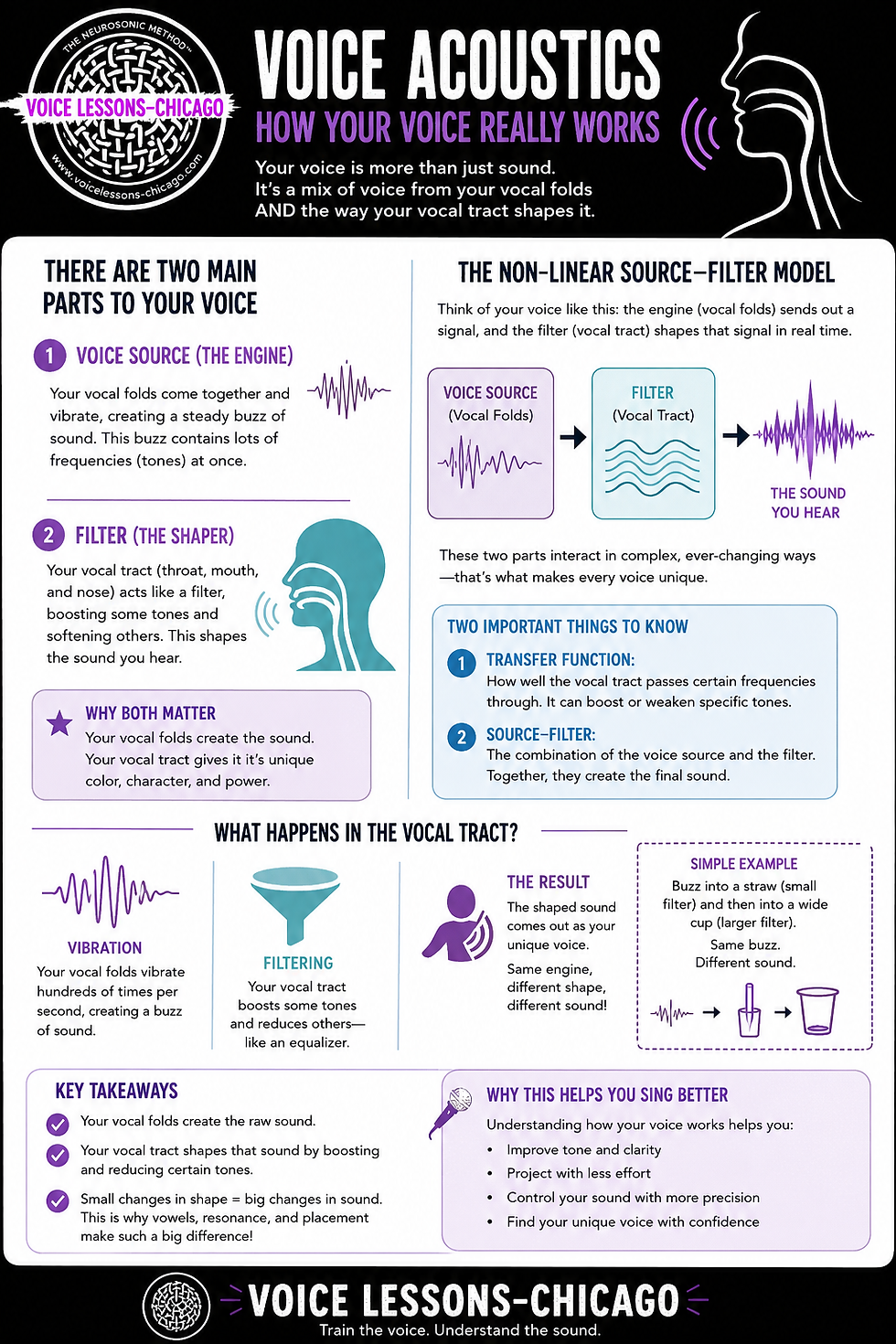
It is a mix of two things working together: the sound your vocal folds create and the way your vocal tract shapes that sound.
This is why two singers can sing the exact same note, but sound completely different. One voice may sound bright and clear. Another may sound warm and deep. Another may sound powerful, breathy, sharp, soft, or full.
The difference is not only in the pitch. It is in how the sound is shaped.
The Voice Source: Where the Sound Begins
The first part of your voice is the voice source. This happens when air from your lungs moves up through your vocal folds. Your vocal folds come together and vibrate very fast. That vibration creates a buzzing sound.
This raw buzz is not your final singing voice yet. It is more like the starting material.
Think of it like the strings on a guitar. The string creates the vibration, but the body of the guitar shapes the sound and makes it richer.
Your vocal folds create the vibration. But your vocal tract shapes it.
The Filter: How Your Voice Gets Its Color
The second part is the filter.
Your vocal tract includes your throat, mouth, tongue, lips, jaw, soft palate, and nasal space. All of these things help shape the sound after your vocal folds create it.
This is why small changes in your mouth or vowel shape can make a big difference.
For example, when you sing a vowel differently, you are not just “changing the word.” You are changing the acoustic shape of your instrument.
That shape can make the voice feel easier, louder, brighter, darker, more open, or more stuck.

Your Voice Is Not One Thing Working Alone
One important thing to understand is that your voice source and your vocal tract do not work separately.
They interact.
Your vocal folds create the sound, but your vocal tract immediately shapes it. At the same time, the way you shape your vocal tract can influence how the voice feels at the source.
This is why singing is not only about “support” or “placement” or “open your mouth more.”
Those things matter, but they are connected. The voice is a whole system.
Why This Matters for Singers
When singers struggle, they often think the problem is only one thing.
They may think:
“My voice is weak.”
“My pitch is bad.”
“My high notes are not there.”
“My tone is not good.”
But very often, the issue is not that the voice is bad. The issue is that the source and the filter are not coordinating well yet.
Maybe the vocal folds are working too hard.
Maybe the vowel shape is not helping the note.
Maybe the singer is adding tension because the nervous system does not feel safe enough to release control.
Maybe the sound is trying to come out, but the vocal tract is shaping it in a way that makes singing harder than it needs to be.
That is why good vocal training is not about forcing the voice. It is about helping the system coordinate better.


A Simple Example
Imagine buzzing into a straw.
Now imagine buzzing into a big cup.
The buzz may start the same, but the sound changes because the space changes.
That is what your vocal tract does. It changes the space around the sound.
Same voice. Different shape. Different result.
This is why vowels, resonance, tongue position, jaw release, and registration make such a big difference in singing.
The Singer’s Takeaway
Your voice is created by vibration, but it is shaped by resonance.
Your vocal folds start the sound. Your vocal tract gives it color, clarity, power, and personality.
When these two parts work together, singing feels easier and sounds more natural.
At Voice Lessons-Chicago, we do not train the voice as a machine that needs to be pushed. We train it as a living system that can learn, adjust, and coordinate.
Because the goal is not to force your voice into someone else’s sound.
The goal is to understand how your voice works, remove unnecessary tension, and help your real voice come forward with more freedom, confidence, and control.
Train the voice. Understand the sound.
Want to take your voice to the next level?
If you feel like you understand what you should do, but your body does not always follow, sometimes your voice does not need more pressure - it needs a new signal of safety.
The Custom NeuroSonic Recalibration Audio uses personalized affirmations shaped through the NeuroSonic Method, built from years of vocal coaching and clinical hypnotherapy practice.
Each audio is created around your specific vocal block, helping your brain and body reconnect so singing can feel safer, freer, and more natural.


Comments